
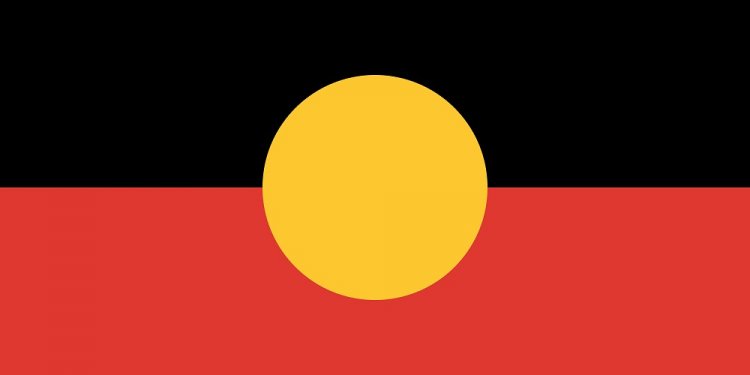
Australian Aboriginal culture facts
 Australian Aborigines
Australian Aborigines are the main indigenous people of Australia. Their ancestors probably arrived in Australia over 50, 000 years ago, although this figure remains in dispute. Aboriginal people from different parts of Australia have their own names for themselves such as Koori, Yamaji, Nunga, Murri etc; these names are specific to various regions. See the note on nomenclature below.
Tasmanian Aborigines settled on that island approximately 40, 000 years ago by migrating across a land bridge from the mainland that existed during the last ice age. After the seas rose, the inhabitants there were isolated from the mainland for 10, 000 years until the arrival of European settlers.
The Aboriginal and Torres Strait Islander people are the indigenous (native) people of Australia. At the time of first contact with the European colonists in the late 18th century, most Aboriginal people were hunter-gatherers with a complex oral culture and spiritual values based upon reverence for the land and a belief in the Dreamtime. The Dreamtime is at once the ancient time of creation and the present day reality of Dreaming.
The exact timing of the arrival of the ancestors of Aboriginal people has been a matter of dispute among archaeologists. The most common view is that their ancestors came from southeast Asia more than 50, 000 years ago. This means there have been more than 1250 generations in Australia. The 50, 000 BP date is based on a few sites in northern Australia dated using thermoluminescence. A large number of sites have been radiocarbon dated to around 40, 000 BP, leading some researchers to doubt the accuracy of the thermoluminescence technique. Thermoluminescence dating of the Jinmium site in the Northern Territory suggested a date of 120, 000 BP. Although this result received wide press coverage, it has been seriously questioned by most archaeologists.
The Aboriginal people lived through many climatic changes and adapted successfully to the different environments. There is much debate about the degree to which Aboriginal people modified their environment. One controversy revolves around the role of Aboriginal people in the extinction of the marsupial megafauna (also see Australian megafauna). Some argue that natural climate change killed the megafauna. Others claim that, because the megafauna were large and slow, they were easy prey for Aboriginal hunters. A third possibility is that Aboriginal modification of the environment, particularly through the use of fire, indirectly led to their extinction.
It is well known that Aboriginal people used fire for a variety of purposes: to encourage the growth of edible plants and fodder for prey; to reduce the risk of catastrophic bushfires; to make travel easier; to eliminate pests; for ceremonial purposes; and just to "clean up country." There is disagreement, however, about the extent to which Aboriginal burning led to large-scale changes in vegetation patterns.
There is evidence of substantial change in Aboriginal culture over time. Rock painting at several locations in northern Australia has been shown to consist of a sequence of different styles linked to different historical periods. Harry Lourandos has been the leading proponent of the theory that a period of hunter-gatherer intensification occurred between 5000 and 3000 BP. Intensification involved an increase in human manipulation of the environment (for example, the construction of fish traps in Victoria), population growth, an increase in trade between groups, a more elaborate social structure, and other cultural changes. A shift in stone tool technology, involving the development of smaller and more intricate points and scrapers, occurred around this time.
Share this article
Related Posts
Latest Posts


